
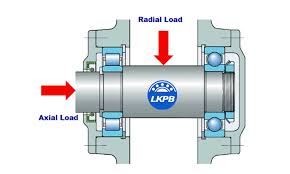
In engineering and manufacturing, knowing the forces involved is key to success. Whether you’re creating a machine or improving a production line, knowing when to use axial load vs radial load can mean the difference between smooth operations and expensive problems.
Imagine you’re facing important choices that could affect how well your work runs and how much money you make. This post explains the two main types of loads, their features, uses, and benefits, helping you choose the best one for your business to improve operations. Ready to elevate your operational strategy? Let’s get started!
Defining Axial and Radial Loads
Axial Loads
An axial load, also called a thrust load, is a force that pushes or pulls along the length of a part or structure.
Advantages
- Efficient Load Transfer: Axial loads are transferred directly along the member’s axis, allowing for straightforward structural analysis and design.
- Uniform Stress Distribution: When properly aligned, axial loads result in uniform stress across the cross-section, minimizing stress concentrations.
Disadvantages
- Buckling Risk: Compressive axial loads can lead to buckling in slender members if not adequately designed.
- Alignment Sensitivity: Any misalignment can introduce bending stresses, compromising structural integrity.
Radial Loads
A radial load is a force applied perpendicular to the axis of a rotating shaft or component. This type of load acts outward from the center, affecting the component’s rotation and stability.
Advantages
- Rotational Stability: Radial loads are effectively managed by bearings designed for rotational applications, ensuring smooth operation.
- Versatility: Many bearings can handle both radial and limited axial loads, offering flexibility in design.
Disadvantages
- Limited Axial Load Capacity: Bearings primarily designed for radial loads may not efficiently handle significant axial forces.
- Wear and Tear: Excessive radial loads can lead to increased friction, heat generation, and premature component failure.
Understanding the distinctions between axial and radial loads is essential for selecting appropriate components and ensuring the longevity and efficiency of mechanical systems.
Comparing Axial and Radial Loads
-
Load Magnitude and Direction
- Axial Loads: These forces act parallel to the axis of a component, either compressing or stretching it along its length. For example, in a hydraulic press, the force applied to compress materials is an axial load.
- Radial Loads: These forces act perpendicular to the axis, pressing outward or inward from the center. An example is the weight of a vehicle acting on its wheel bearings, which applies a radial load.
- Understanding the direction and magnitude of these loads is crucial for designing components that can withstand operational stresses.
-
Bearing Selection
- Axial Loads: Thrust bearings are specifically designed to handle axial loads. They support forces parallel to the shaft and are commonly used in applications like automotive transmissions and vertical shafts.
- Radial Loads: Deep groove ball bearings and cylindrical roller bearings are suited for radial loads. They support forces perpendicular to the shaft and are prevalent in electric motors and conveyor systems.
- Combined Loads: Angular contact ball bearings and tapered roller bearings can handle both axial and radial loads, making them ideal for applications like gearboxes and machine tool spindles.
Selecting the appropriate bearing type ensures optimal performance and longevity of mechanical systems.
-
Stress Distribution
- Axial Loads: Axial loads push or pull evenly along a part, but it can bend or break if it is thin or not strong enough.
- Radial Loads: Radial forces create bending moments that cause uneven stress across a component’s cross-section, which can lead to bending and fatigue over time.
Proper analysis of stress distribution enables the design of components that can resist deformation and failure under operational loads.
-
System Design Considerations
- Material Selection: Materials must be chosen based on their ability to withstand the specific type of load. For axial loads, materials with high compressive or tensile strength are preferred, while for radial loads, materials with good bending resistance are ideal.
- Component Geometry: The shape and size of components should be designed to distribute loads effectively. For example, increasing the diameter of a shaft can reduce bending stress from radial loads.
- Alignment and Support: Ensuring proper alignment and support can mitigate the adverse effects of both axial and radial loads. Misalignment can lead to uneven load distribution and premature failure.
Incorporating these considerations into system design enhances reliability and efficiency.
Knowing the differences between axial and radial loads helps engineers design efficient, long-lasting mechanical systems by choosing the right bearings and managing stresses effectively.
Case Studies: Real-world examples illustrating the application of axial and radial loads in different industries.
Axial Load Applications
- Hydraulic Press Design: Engineers used simulations to manage strong axial forces in a 100 MN press, ensuring safe and effective operation.
- Marine Propeller Shafts (Container Ships): Designers optimized bearing selection and lubrication to handle propeller thrust, improving maneuverability and reducing vibration.
- Submarine Shafts: Combined thrust–radial bearings and precise lubrication systems helped submarines handle axial loads quietly and reliably underwater.
- Warship Bearings: Naval thrust bearings were improved with better materials and lubrication designs to withstand continuous axial loads from turbines.
Radial Load Applications
- High-Speed Machining Spindles: Angular contact ball bearings with optimized preload, reduced vibration, and improved machining quality.
- Automotive Assembly Lines: Switching to spherical roller bearings extended bearing life from 3 months to over 36 months, greatly reducing downtime and improving overall efficiency.
- Wheel Bearing Fatigue (Cars): Engineers performed stress analysis on car wheel bearings to identify weak points caused by repeated radial loads. By improving the materials used, they successfully doubled the lifespan of the bearings, enhancing durability and reducing maintenance needs.
- Mining Conveyor Rollers: Real-time IIoT monitoring enabled predictive maintenance, reducing breakdowns by 30% and increasing service intervals.
- Wind Turbine Bearings: Better lubrication strategies for bearings handling combined loads extended maintenance intervals by 25%, boosting efficiency.
Properly managing axial and radial loads ensures machines run more efficiently, have a longer lifespan, and require less maintenance across various industries.
Choosing the Right Load Type for Your Business:
Key Factors to Consider
- Load Direction:
- Axial loads act along the shaft (push/pull).
- Radial loads act across the shaft (side pressure).
- Speed: Radial loads are better for high-speed systems.
- Bearing Type: Use the correct bearing thrust for the axial and deep groove for the radial.
- Environment: Temperature, moisture, and dirt impact performance.
- Space: Axial load systems often require more compact designs.
Long-Term Considerations
- Axial Loads: They need accurate alignment and consistent lubrication. When properly maintained, they improve system stability and overall performance.
- Radial Loads: Require regular inspections to avoid failures and maintain long-term efficiency.
Compare the initial costs with future maintenance and how well it works to make smarter, money-saving decisions.