
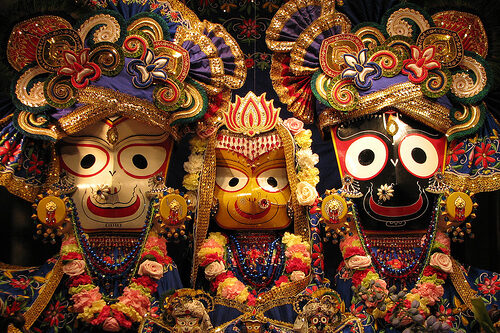
When the streets of Puri are filled with conches, cymbals, and mantras in the month of July, you know Rath Yatra has descended upon you. It is not a festival — it’s a moving temple, a thundering ocean of faith on wheels. The Rath Yatra, or Chariot Festival, is a majestic procession where the three gods — Lord Jagannath, Balabhadra, and Subhadra — set out on the streets in enormous chariots, propelled by thousands of hands and even more hearts.
This holy tradition isn’t all about show. It’s a living metaphor of gods descending to greet their followers, of movement signifying life itself, and of chariots symbolising our bodies, guided by the will of the gods. But who are these gods, really, and what makes their appearance on the rath so spiritually potent?
Let’s lift the veil on the divine trio of Rath Yatra and their contributions to this gargantuan event.
The Spiritual Significance of the Divine Trio
Every god on the Rath Yatra occupies a singular space in the spiritual world, as different energies pouring into a shared river of bhakti.
Lord Jagannath — The Lord of the Universe
Lord Jagannath, a form of Krishna, is the unborn force of love and compassion. His large, rounded eyes and incomplete body represent the unknowable nature of the divine. He’s the magnet of the festival — the one whose darshan moves millions.
Ponder the chariot as life’s journey, and Jagannath as the charioteer, guiding you through joy and sadness with godly equipoise.
Balabhadra — The Pillar of Strength
The elder brother, Balabhadra (or Balarama), is a symbol of strength and righteousness. He stands as a reminder that dharma (righteousness) is what keeps life going. He drives alone in his chariot, the Taladhwaja, and is usually a symbol of the raw power of nature tempered by moral will.
Subhadra — The Feminine Divine
Subhadra, the sole goddess on board, graciously occupies the middle seat between her brothers. She is Shakti — divine feminine power, the binding force of the universe. Her chariot, Darpadalana, represents inner harmony and intuition.
When Is Rath Yatra 2025?
Mark your calendar — Rath Yatra in 2025 is on 29th June (Sunday). It’s celebrated every year on the second day of the Shukla Paksha (waxing moon phase) in the month of Ashadha according to the Hindu calendar.
Here’s a brief run-through of the key events:
- Snana Purnima: Ritual bathing of the deities (10th June 2025)
- Gundicha Yatra (Main Rath Yatra Day): 27th June 2025
- Hera Panchami (Visit by Goddess Lakshmi): 30th June 2025
- Bahuda Yatra (Return Journey): 4th July 2025
- Suna Besha (Golden Attire of Deities): 5th July 2025
Rituals, Beliefs & the Magic of Bhakti
The festival is not merely about chariot pulling; it is a highly symbolic and personal act of worship.
- Pulling the chariots: Often believed to cleanse sin and provide moksha.
- Trip to Gundicha Temple: Symbolises the gods taking a trip to their place of birth.
- Return to Jagannath Temple: Symbolises the cyclical movement of time and rebirth.
These rituals reflect the same religious fervour that makes the faithful book pooja during other significant festivals, like Hanuman Jayanti, when Hanuman ji ki puja is done with enthusiasm in order to get strength and protection.
The Significance of Hanuman Ji in Rath Yatra’s Spirit
Although Hanuman Ji is not among the three gods in the chariots, his essence is deeply rooted in the values that the festival nurtures. His unshakeable devotion, power, and humility reflect what is demanded of a devotee during Rath Yatra.
And just as Hanuman ji ki puja is an appeal for service and bravery, pulling the chariot is an act of complete surrender.
Hanuman’s jump over the oceans is a reminder of our leap of faith, as Jagannath leaves his sanctum for his believers.
A Festival That Moves People — Literally and Spiritually
From Puri’s Grand Road to distant temples like Trimbakeshwar Jyotirlinga, the ethos of Rath Yatra has inspired parallel processions across India. These events become spiritual magnets, drawing crowds not only for the darshan but for the experience of singing, serving, and surrendering.
Yet, not everyone can make the physical journey.
Utsav-The Ideal App
In such moments, Utsav quietly enters the frame. Without being boisterous, without demanding attention, Utsav is facilitating pujas remotely for thousands who crave a bond. From the Triveni Puja at Kumbh Mela to a simple Hanuman ji ki puja in your home, Utsav makes sure your faith isn’t geographically bound. With access to sacred places such as Shaktipeeths and Jyotirlingas, Utsav makes it easy to book pooja in a few clicks — no queues, no missed slots, just unadulterated, uninterrupted bhakti.
For busy working professionals, elderly parents, or NRIs, this is not convenience — it’s a spiritual bridge.
Conclusion: The Journey Within
Rath Yatra is not just about seeing the gods roll by on their giant chariots. It’s about having them roll into your heart. It’s about movement — not of gods, but of faith. In a noisy world, Rath Yatra is a majestic, thundering reminder that faith moves — it travels, changes, and touches.
And for those who can’t be in Puri in body, don’t worry — you don’t have to miss the spiritual train. With Utsav, India’s favourite dharmik app, you can schedule poojas, take darshan, and get prasad from divine temples from the comfort of your own home. The app is listed on the Play Store, a click away, always eager to bridge you with your faith.
So this Rath Yatra, whether you’re pulling the chariot or just pulling up the Utsav app, the gods are already on their way to meet you.
Jai Jagannath!
Let your journey begin.


